

The Rhythm and Routine
Forming habits that could improve your writing rhythms
Hey there, I’m Edward Holmes, a hope-filled writer, publisher, poet and podcaster here to share stories and poetry with you and for you. Take a moment to like this post so that others, like you, can find lines of life in their creative journey. If my words bring you hope, consider subscribing for free. It’ll make me pretty happy.

Okay! So I’ve got some good habits and some bad ones, and without disclosing which are which, I’ll list them here for your own personal assumptions:
7pm Thursday night snack runs.
Early morning donut runs. (before work)
Making my bed first thing after waking.
Writing one spilled-ink poem each week.
Late-night jogs with a podcast.
Midday snack runs.
A horrible sleep schedule.
Theology rabbit-holes.
Reading one new book a month.
I think you get the gist. There are some things that impact my health and overall well-being in a negative way, and they are by no means, the snack runs. Our habits help us to become the best or worst version of ourselves, and as we continue practicing them, we essentially become our habits.
Lately, I’m starting to realize that becoming a better writer involves forming good habits around my craft. This month, I want to share three with you that might be just what you need as you launch into this new year of creativity.

Habit #1: Stay in the Word(s)
Remember the time, you discovered a new word and wanted evereyone to know you knew it? Remember that? For me in 2026, there’s four of them: idyllic, ephemeral, wistful, and sibilant. Huge candidates for word of the year, right? As a poet, I try to keep a growing repertoir of words handy. Sometimes choosing the right word over another could elevate your current piece dramatically.
Check out this example:
Amidst unsettled waves, I saw
my savior motion silently.
but fear became the new refrain
from stepping out into the sea.
Now let’s change up a few words and see how it reads.
Amidst the nauseous waves I saw
my savior signal silently,
but fear became my new refrain
from treading seas so ill at ease.
A few tweaks bring out more sound and imagery in the poem. Calling the waves “nauseous” presents a stronger image than “unsettled.” “Savior signal silently” moves the poem along with sibilant (there it is!) alliteration. And finally, we end the poem with “ill at ease” which rolls off the tongue smoother than “stepping out into the sea.” (In my opinion.)
For the poet reading this, using your thesaurus is your multi-tool. A habit I recommend in 2026 is building your vocabulary by just one word, daily.
To avoid providing an exhaustive list you’ll scroll past, let me recommend the holy grail: Dictionary.com. I currently use an app called Daily Word, and it does the job of force-feeding me new words like I’m at a Golden Corral on a Sunday afternoon.
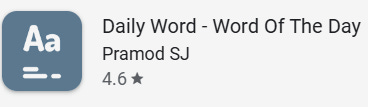
This app was one of those I found to be free of charge and pulls your daily word right from Merriam Webster. If that’s your thing, I highly suggest assimilating this habit into your life post-haste. Now let’s talk about rhyme…

Habit #2: It’s Rhyme Time.
When writing a poem, you’ll typically have an idea, theme, and direction on where to take your audience. There are moments, however when you’ll hit a wall trying to find the right rhyming word. Has this ever happened to you?
Of course it hasn’t because after checking your search history, I’ve discovered that you’ve been using rhymezone.com. Don’t be afraid… it’s not public knowledge yet, but your secret’s safe with me.
Rhymezone serves as a thesaurus of sorts for… well… rhymes, and comes in clutch when you’re unable to find the right word to carry your narrative forward. Of course, as with any tool, be sure that you understand the meaning of the words you’re using in your poem first. A good rhyme is important, but so is a poem that won’t make your editor question your competency.
Habit #3: Listen Up!
Stay inspired by voices you resonate with. Listen to their podcasts, read their literature, or experience a live show. Go deep! Here are a few that keep my tank full of inspiration and intrigue. (In no particular order, of course)
Kimberly Phinney - For her mastery of the written craft and undying honesty.
Jason Fullerton - For his warm, down-to-earth, and easy-to-embrace poetry.
Ashley Sposato - An eloquent bard of the wilds, writing 20 years beyond her age.
Tanner Olson - For his consistency as a voice of encouragement to everyone he meets.
Levi Macallister - For invigorating spoken word and storytelling.
Nicholas Trandahl - For his raw and nearly meditative poetry and spoken word.
Some of these writers have been featured on a podcast I host with Deidre Braley, so if that’s your cup of tea, check it out for a little inspiration, yourself.
My playlist is heavier than what I’m about to list here, with plenty that aren’t aligned by any faith construct or religion. However, for the sake of brevity, these are some to consider.
Bonus: Listen to poetry you don’t like, too. Don’t be afraid to consume something that might challenge your comfort zone.

Writing is not confined what we do when we sit down, it’s who we are becoming when our pen is far from my page. It’s the way observe and consume the literary world around us. It’s how we meditate on the etymolological history of words and practice using them. It’s giving respect to the voices that empower and inspire us.
We become our habits as we continue to practice them, and eventually what we make time to do becomes second-nature. This month, don’t be afraid to use some of the writing tools, apps, and resources we have at our disposal to tell powerful narratives through the written word.
I look forward to all of your overly pretentious word usage in the coming days.
Write on, beloved.
📷Instagram / ✉️edwardlholmes@yahoo.com /📺 YouTube / 🎙️Poetry Podcast
Thanks for the nudges to keep climbing those hills to change up our vocab! I ALWAYS need to tweak old words for newer and better ones!
Thanks for these thoughts and resources! :)